



Why data sovereignty now?
This summer, the cabinet wrote to the House of Representatives stating that dependence on American cloud providers is “geopolitically and strategically no longer sustainable.” A dedicated sovereign government cloud is being developed.
As a civil servant at the Education Executive Agency (DUO), I realized how much sensitive data an executive agency collects and processes, including data from millions of students and former students.
What changes are we seeing in the legal landscape?
The CLOUD Act grants the U.S. government access to data from American companies, regardless of where that data is stored. The debate surrounding data security is shifting. For instance, the German state of Schleswig-Holstein transitioned nearly 80 percent of its workstations to open source. We expect to see these types of choices more frequently in future tenders.
Data sovereignty sounds like a significant undertaking. At its core, it involves three questions: Where is my data located? Who can access it? Which jurisdiction does it fall under?
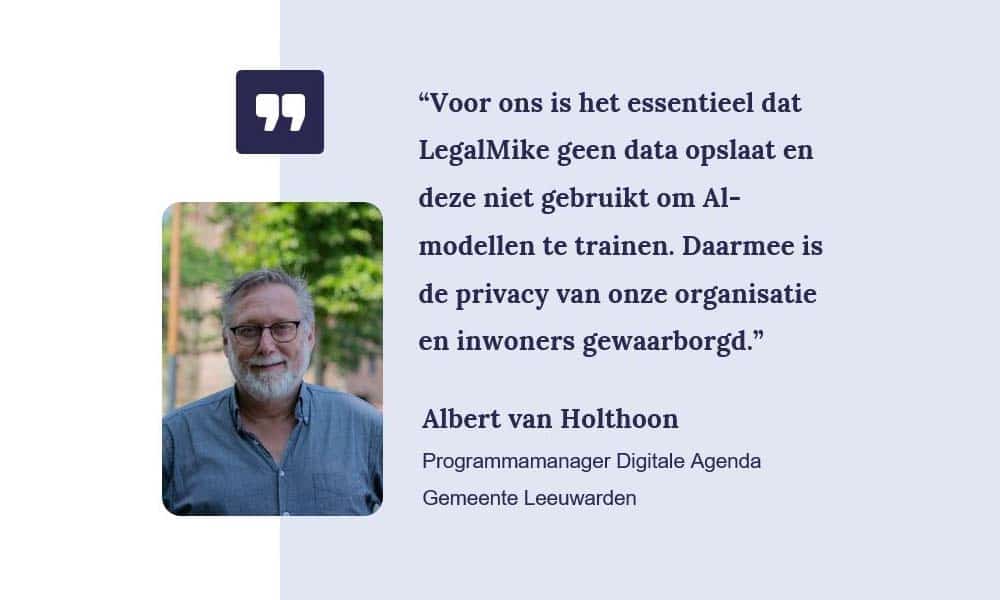
At LegalMike, we opted for zero data retention from day one. This is not standard in the market. What you enter is not used for training and is not stored on external servers (such as those of OpenAI or Microsoft). We are aware that this sometimes costs us speed. We make no concessions on security, given our clients and the times we live in. Albert van Holthoon of the Municipality of Leeuwarden articulated this well below.
In the coming period, we will go a step further. We will then offer a fully data-sovereign version of LegalMike for every (government) organization that truly wants to keep its (legal) data under its own control.